In September 2011, Mike and I took an amazing trip to Germany and Austria for 16 days!
Day 1: Baden-Baden and Staufen
Mike flew out to Germany first to present at a conference in Frankfurt, Germany. He was there for about a week, then I flew out to join him on Friday, September 16. I arrived in Frankfurt around 6am on Saturday, September 17. We successfully found each other in the airport around 7am. (We had worked out a meeting spot just outside baggage claim, but without cell phones, we were both a little nervous about this; thankfully, everything worked out just fine!) We made our way downstairs to the long-distance train platform (which is conveniently located right in the basement of the airport!), found a bench and caught up with one another while we waited for our train.
I'm going to pause here to say a few words about the trains in Germany because we rode the trains almost every single day of our trip. Train lines cross the entire country of Germany making it possible to get just about anywhere by train. Trains (including inter-city subway systems) and the occasional bus were our exclusive means of travel within Germany. We never found it necessary to rent a car or even take a taxi ride. We both thought traveling by train in Germany was fantastic! The trains were clean, comfortable, and on-time. Even though neither of us can speak German, we had no problem figuring out the platform signs and which stop to get off at (well, we made a few mistakes, but nothing too serious). When we did need help, the employees were so nice and helpful. We did the math and found that for our plans, the passes would actually cost more than just purchasing tickets individually (I think largely because we rode mostly regional trains, which aren't too pricey). But we did save a lot of money by purchasing our tickets online in advance. The
Deutsche Bahn website was so easy to use! I actually bought most of our tickets at home before we left, printed them out, and brought them with us.
I also think this would be a good time to talk about our luggage. This trip was our third vacation to Europe together, and each time we've tried something different as far as luggage. On our first trip, in 2007, we each took a duffel bag. Those ended up being pretty inconvenient to tote around because they were heavy and difficult to carry. On our next trip (our honeymoon in 2010), we decided to share a large rolling suitcase. That worked ok whenever we were able to roll it, but was very heavy and difficult to load on and off of public transportation, on stairs, or on cobblestone streets (of which there are many in Italy). For this trip, we wanted something different. Knowing we'd be changing locations every two to three days, and riding lots of public transportation, I immediately thought of backpacks. I was nervous that we wouldn't be able to fit everything we needed for 16 days (me) and nearly three weeks (Mike) in a backpack. But after some discussion, we decided we could make it work.
I found these bad boys for a great deal at the REI outlet online:

They're called the REI Venus (mine) and Mars (Mike's) backpacks. They got great reviews, had all the features I wanted (internal frame, hip belt, zip down front), were generously sized, and, since they were older models, were on sale for just $80 each! They ended up working perfectly, and I don't see us ever traveling without them again. They were comfortable to carry, easy to get on and off, and didn't even feel all that heavy once they were on. Using backpacks did force us to pack lighter than we've ever packed before, but I really didn't feel all that inconvenienced by it. In fact, I still probably over packed. Next time, I'll try to take even less stuff. I was able to fit a clean shirt, pair of socks and underwear for each day of the trip, so I didn't need to do laundry (I didn't want to waste valuable vacation time sitting in a laundromat). I brought one pair of shoes (the ones on my feet), four pairs of light weight pants (including some that could roll up to be capris if it was hot), a zip up sweatshirt and a jean jacket (which I could layer together if it was really cold). I was worried that stuffing my clothes into a backpack would make them horribly wrinkled, but by rolling things together, it wasn't too bad. But let me tell you, being able to carry all our luggage on our backs was so incredibly convenient! It enabled us to jump on and jump off trains quickly (and sprint for the train if we were running late). They fit on the metal racks above our train seats so we could keep an eye on our bags rather than leaving them on a luggage rack at the other end of the car. A couple times, we wanted to stop and see a city in between hotels, and we were able to fit both our backpacks into one locker at the train station. It was SO NICE!!!
Ok, now back to the trip. Our first stop was Baden-Baden. This is a town in the Black Forest (in German, "Schwarzwald") region of Germany that dates back to the Roman era. The Romans built bath houses to take advantage of the thermal waters present here. Today, Germans still believe these waters have healing powers (I read that the German national healthcare system actually covers one trip every decade to the baths) and thus the town and grown into an upscale resort town. We picked it as our first stop mainly because of convenience (trains run directly from the Frankfurt airport to Baden-Baden every two hours) and because I thought a relaxing day at the spa sounded perfect after a long international flight. :)
 |
| Baden-Baden, center of the "old town" |
Our train got into Baden-Baden around 10am. We stowed our backpacks in a locker at the train platform. A little cafe next to the train station caught our eye, so we stopped in for a cup of coffee and a pastry (I'd already been up nearly 24 hours, and I badly needed some espresso to keep going!). I picked a pastry with plums on it that was really good! I ended up seeing pastries like this throughout Germany, and I'm not sure what they're called, but I highly recommend them! After we finished eating, we caught the bus into town and headed straight for the baths.
 |
| Friedrichsbad, the Roman-Irish bath house |
There are two main bath houses to choose from: the more traditional Friedrichsbad (a.k.a., the Roman-Irish bath), and Caracalla (a more social, family-oriented, pool complex). For us, the choice was easy. The Roman-Irish baths are the ones with all the history, and that's what we came here to experience. After a visit here, Mark Twain wrote to a friend, "Here at the Friedrichsbad you lose track of time within 10 minutes, and track of the world within 20...." Now, the reason not everyone chooses to go to the Roman-Irish baths is because...they're nude.
Now I'm not overly prudish, but still, the idea of a bunch of strangers seeing me butt naked made me slightly uncomfortable. But the truth is, Europeans view nudity very differently than Americans. For example, it's just fine in their eyes to sunbath nude in a public park. Everything I read about these baths said it was a serene, respectful experience, free of leering. So I decided to be brave and give it a try.
There are two almost identical sides to the bath, and on certain days of the week it's either separate for men and women, or mixed. I was actually hoping to go on a mixed day so that Mike and I could go through together, but we ended up there on a separate day. However, there's still one pool in the middle which is always mixed. We were able to time it right so that we got there at the same time and had a least a short time to talk and compare notes.
The bath house is really an incredible place. The website is
here if you want to see some pictures of what it looks like inside. It's done in a very grand, elegant, Roman style with lots of marble, pillars, and a large domed ceiling over the center pool. It almost felt like stepping back in time!
The bath experience consists of 17 steps. On the wall in every room, there's a sign that explains what the room is and how long you're supposed to stay there. If you stick to the schedule, you will finish in 2.5 hours. You begin with a shower, then a dry sauna, then a hotter dry sauna, then another shower (different temperature), then a soap brush massage, then another shower, then a steam sauna, then a series of pools of different temperatures. You pay a little extra for the soap brush massage, but it was totally worth it! They use a soft bristled brush and a nice olive-oil soap and scrub you all over.
The entire experience was soooooo relaxing. True to what other said, I didn't mind being naked at all. Even in the pool where it was men and women together, I never felt uncomfortable. No one stared. Everyone was just doing their best to relax, usually with their eyes closed or staring at the ceiling. I was surprised how comfortable I felt the whole time! The only time I felt nervous was stepping out of the changing room naked. Mike said the same thing. But as soon as I saw other women walking around naked, I felt a lot better and was easily able to relax as soon as I reached the first shower.
The last step is a quick dip into an icy cold bath followed by drying off off using a warm towel. Then you rub lotion all over yourself and go into a quiet room where they wrap you up in a cocoon of blankets and let you rest for 30 minutes.
Now, at this point, I had been up for well over 24 hours, and I'd been fighting jet lag pretty well up until this point. But after 2 hours of relaxing hot tubs and massage followed by being wrapped in blankets in a quiet room, I caved in and fell pretty soundly asleep. Really, it's a small miracle I woke up at all! If you stay too long, they charge you extra. Seems like kind of a dirty trick to me... ;) But thankfully, I made it out before my time expired. Mike was a little nervous though. He'd been outside waiting for me and was about to ask someone to go find me because he was concerned I was sound asleep!
After that, we wandered the old town a little bit.
We had lunch at Peter's am Leo Cafe - an inexpensive place recommended by Rick Steves, right in the central square. Then our plan was to walk up to the historic Lichtentaler Allee, but we didn't get very far before it began to rain lightly. We had left our ponchos in our packs at the train station, so we decided to call it a day and head back to the bus stop. We had just boarded the bus when it began to rain cats and dogs! We were lucky we decided to head back when we did. I still managed to get a few pictures of the picturesque park before it began raining too hard:


We collected our bags from the locker at the train station and boarded the train to Staufen, a little town in the southern Black Forest region, where we'd be spending the night. Unfortunately, our train from Baden-Baden to Bad Krozingen, where we had to change trains, was delayed about 10-15 minutes, so we missed our connection to Staufen and had to wait an hour for the next one. By the time we arrived in Staufen, it was about 8pm and getting dark. We were staying at the Gastehaus Kaltenbach, a family run bed and breakfast on a working horse farm. Rick Steves said it was just a 10 minute "moderately uphill" walk from the train station. Well, with backpacks on and as tired as we were, hiking in the dark, it didn't feel very "moderate" at all. It took us at least 15 minutes to climb it (although it felt like it took forever!). There are no street lights up there, and we didn't have flashlights handy, so finding the place was tricky. But we made it, and the innkeeper, Gaby, was very gracious about checking us in late.
 |
| Gastehaus Kaltenbach, in the daytime |
 |
| This is the hill we had to walk up to get there. You can imagine in the dark...it's really dark! |
After we set down our bags in our room and got a tour of the B&B, we walked back down the hill into town (with flashlights this time) to see if we could find a bite to eat because we were STARVING. At nearly 9pm, most of the restaurants in this small town were already closed up and we were seriously concerned about whether we'd find anything for dinner at all. But when we found our way to the main street of town, we stumbled upon...a medieval festival, in full swing!!! It was really a sight to see. Everyone was walking around in medieval costumes, there were merchants selling medieval style clothes and toys, there was a stage with people singing and dancing, food was being roasted over open fires, and lots and lots of German wine and beer was being sold (they have no issues with open containers of alcohol in public here, people drink everywhere - such a great country!). We could not believe our luck! We went from having zero dinner options to plentiful, inexpensive festival food everywhere!
First we tried this pizza-style dish. It had a thin crust, some kind of cream sauce, white cheese, with bacon and mushroom toppings. They cooked it in an old-style brick oven and served it to you nice and hot. It was delicious! After that, I was longing for a big Bavarian pretzel, while Mike got some ribs that were being slow roasted over a hanging fire. And of course, we both got a beer.
We were just eating and wandering around, when all of a sudden, a parade started! We stood and watched as a band marched through town, followed by over 100 people in different medieval costumes, all singing and carrying torches. There were knights, ladies, friars, peasants - all marching through town by fire light. It was really, really cool! Way better than any Renaissance festival I've ever seen in the U.S. (but perhaps that's to be expected when you're actually in a town that dates back to Medieval times, I don't know).
After the parade, things seemed to be wrapping up, and we were truly exhausted, so we headed back to our B&B and crashed. But the food was so good, we ended up coming back to the festival the next day for dinner, so I was able to take some pictures in the daylight:
Day 2: Freiburg
On Sunday, September 18, we took a day trip to another small Black Forest town - Freiburg. There's really not much to Staufen that isn't in the pictures above. It's truly a very small town. But it's cute, quiet, non-touristy, inexpensive, and conveniently located on a train line, so really it's the perfect place to stay while you see the southern Black Forest. It does in fact date back to medieval times (as the medieval festival would suggest) and there are these cool castle ruins high above town, today surrounded by a picturesque vineyard:
After having breakfast at the B&B (one of the best breakfast spreads of our trip - complete with varieties of homemade jam!), we hiked back down the hill and caught the train to Freiburg.
Freiburg is much larger than Staufen. It has both a busy, modern part and a much quieter, historic
Altstadt, or old town (where we spent our time). The main attraction in Freiburg is a grand medieval era cathedral. We actually learned once we got there that the pope was coming to visit the cathedral on the following weekend! Hence the poster you see here above the entrance:


After touring the cathedral, we went to find some lunch. Rick Steves didn't have a lot of suggestions for where to eat in Freiburg, so we just wandered around until a microbrewery caught our eye. I wish I'd made a note of the name of the place, because we ended up having the best beer, and one of the best meals, of our entire trip there! My dish was basically a big plate of potatoes covered in cheese, but it was really delicious cheese and tasted amazing! Mike had some schnitzel. It was actually kind of a let down to have such amazing beer on the second day of our trip, because we kept comparing all others beers to that one. I did take a picture of the brewery equipment (I'm not sure what the technical name for this is) visible behind the bar because I thought it looked so cool:

After lunch, we wandered around the old town a bit. It's a quiet, largely pedestrian-only area full of pretty, traditional-style buildings. There's not really any attractions to see here, but it made for a relaxed afternoon of aimless wandering and picture taking.
 |
| Medieval city gates |
 |
| This is Freiburg's bächle - tiny streams flowing along the main streets that date back to the medieval times when they served as fire prevention and street-cleaning system |
We had planned to do a little hiking, but unfortunately the weather was cold, overcast, and threatening to rain at any moment, so we decided not to. That's really my only regret of the entire trip - that we didn't get to see much of the actual Black Forest. I guess we'll just have to go back some day!


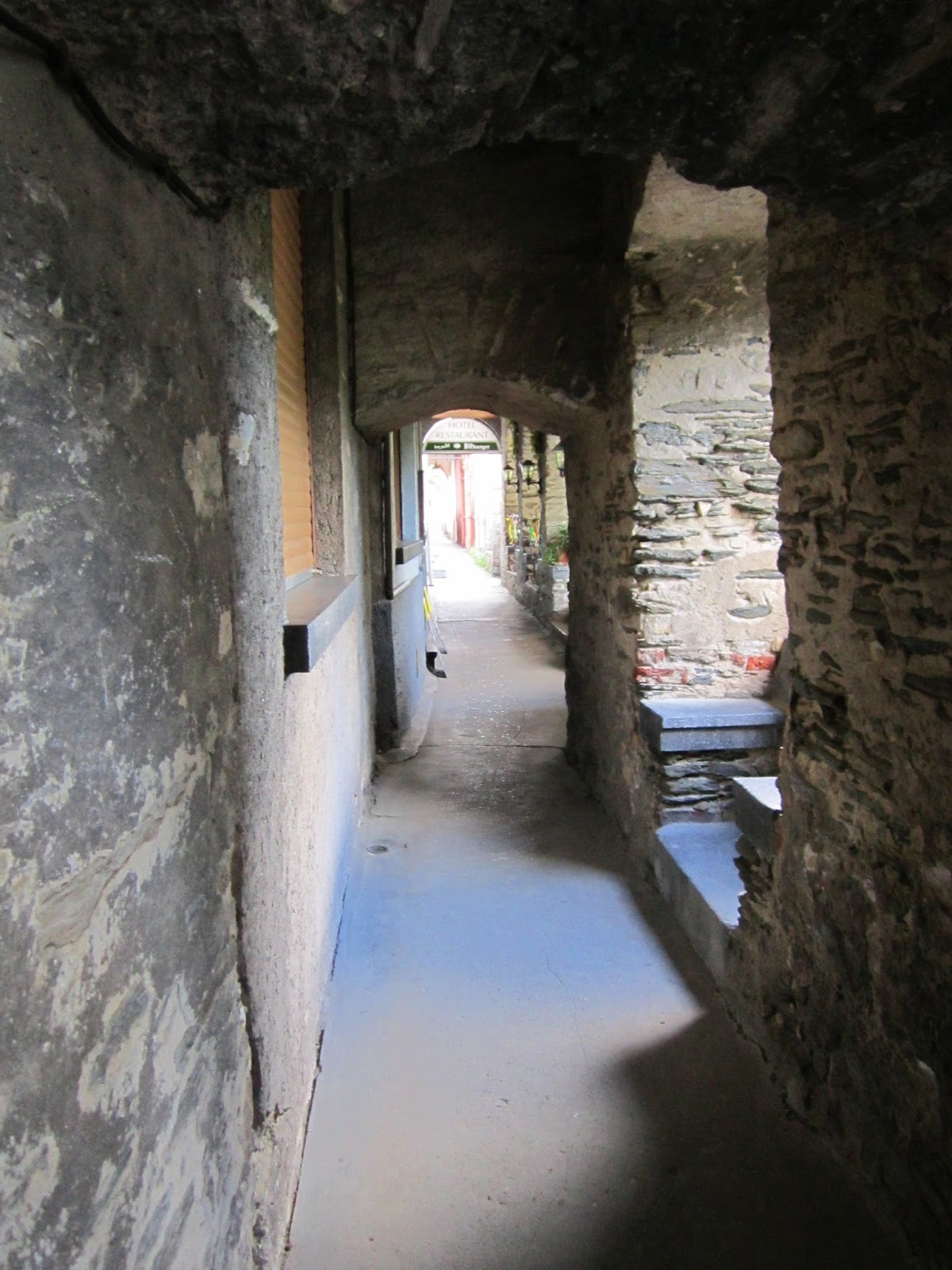

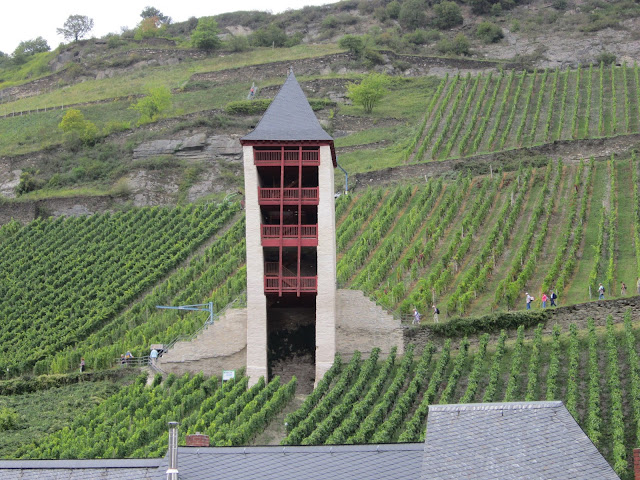


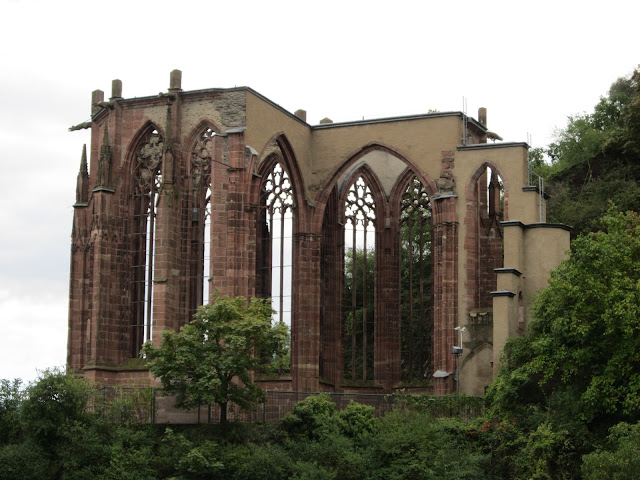


 Central Bacharach was filled with traditional half-timber houses and old cobble stone streets


 We ended our walk in a beautiful part of town. The entire area looked like a secret garden! There was a tiny stream with quaint little stone bridges crossing it, lush green plants growing everywhere, lovely bright colored flowers dotting the landscape, and it was all surrounded by picturesque half-timber houses. We found a bench and sat for awhile just enjoying the view.


 For dinner, we went to a place recommended by Rick Steves called Altes Haus. It's a very old building (it says 1368 on the side, although we read it was actually built around 1568). And the inside definitely has a lot of character. But that's about all the positive things we can say about it. It was absolutely freezing inside, and we told the waitress, but all she did was shut the door - it didn't help much. So that made it difficult to enjoy our meal. Carolyn thought her food was just ok; Mike didn't like his at all (he ended up getting some pizza later). We left pretty disappointed.
 After dinner, we were going to do some wine tasting in town at two placed recommended by Rick Steves, but one was closed and the other had it's doors wide open - and we'd had enough of freezing restaurants! So we returned to our hostel and got a bottle of Riesling from the cafeteria instead (for half the price that the wine tastings would've cost!). We weren't sure what quality of wine we were going to get at these low prices, but it turned out to be incredibly good! And best of all, the cafeteria was nice and warm. Not a bad way to end the day. :)
 The boat ride from Bacharach to St. Goar takes about an hour. We sat on the top deck and read Rick Steve's description of the scenery we were seeing as we traveled down the river. The weather was perfect - it was a bright sunny day - and made for a very pleasant cruise.


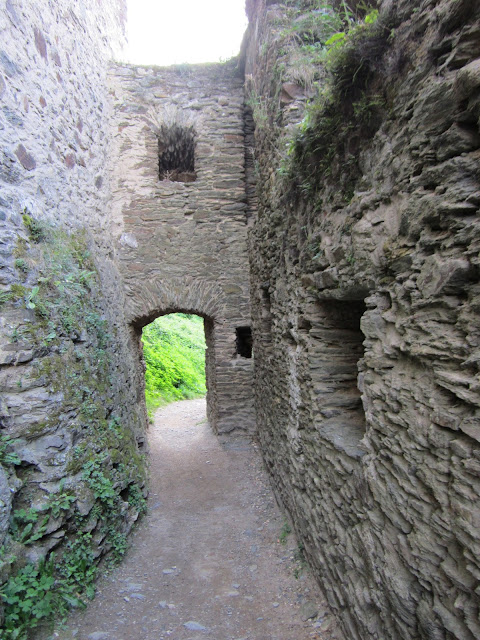


 After lunch, we walked around St. Goar for awhile.
  But St. Goar is a very small town, and we ran out of things to do pretty quickly. So we caught the boat back to Bacharach. The return trip is a bit longer - about an hour and a half - since you're going upstream. But it was still sunny and warm, so we enjoyed sitting on the top deck watching the castles and cute little towns go by once again.


